Plasma Pre-treatment for Metallic Printing on Cotton
Replacing Wet Chemistry in Textile Printing: Air Plasma Pre-treatment for Metallic Pigment Printing on Cotton
A Heriot-Watt study using a Henniker HPT-200 shows that a dry, air-only plasma step can replace conventional wet pre-treatment, cutting the water penetration time of grey cotton from over 20 minutes to 6 seconds while improving print durability and reducing pigment discharge to wastewater.
The Challenge: A Sustainability Problem Built Into the Process
Metallic pigment printing, which produces the gold and silver effects widely used on printed cotton textiles, has to overcome a basic materials problem before any ink reaches the fabric. Cotton fibre is naturally hydrophobic, its surface coated with waxes, pectins and other impurities that resist water. Printing pastes struggle to wet and anchor to that surface, and the result is poor colour fastness: pigment that washes out, rubs off, or bleeds during laundering.
The conventional remedy is a sequence of wet chemical pre-treatments (scouring, bleaching, mordanting and chemical activation) using sodium hydroxide, hydrogen peroxide and organic solvents to strip the fibre and open it up to the ink. These processes work, but they consume large volumes of water and energy and generate wastewater loaded with high chemical oxygen demand, suspended solids and residual colourants. For an industry under growing regulatory and commercial pressure to reduce its environmental footprint, pre-treatment is one of the least sustainable stages of the printing chain.
The question the research set out to answer was direct: could a dry, low-chemical surface process deliver the same printability without the water use and the effluent burden?
How plasma treatment supported this research
Researchers at Heriot-Watt University investigated low-pressure air plasma as a sustainable alternative to wet pre-treatment. The work was carried out on a Henniker HPT-200 vacuum plasma system, treating two woven cotton fabrics (a grey loom-state baft and a bleached cotton) before screen printing with gold and silver metallic pigments.
The plasma process used air as the working gas at a power of 200 W, a chamber pressure of 1.67–1.76 mbar and a gas flow of 15 sccm, comparing two exposure times of 3 and 5 minutes. Plasma surface treatment played a crucial role in preparing the fabric for print. A plasma discharge ionises the air inside the chamber, generating a population of reactive species (ions, electrons and free radicals) that bombard the fibre surface. Two things happen as a result.
Chemical functionalisation. The reactive oxygen species oxidise the cellulose surface and graft oxygen-containing polar groups onto it. ATR-FTIR spectroscopy confirmed this directly: a new absorption band appeared at 1733 cm⁻¹ in treated samples, the signature of carboxyl groups formed by oxidation. XPS quantified the shift: on grey cotton the hydrocarbon (C–C/C–H) component fell from around 57% to 37%, while oxidised carbon species rose correspondingly. The result is a remarkable and immediate increase in surface energy, which is what allows the printing paste to wet the fibre.
Physical etching. Ion bombardment also micro-roughens the fibre surface, increasing its effective area and creating mechanical keying points for the pigment paste to anchor to. Critically, this modification is confined to the surface: XPS showed the bulk cellulose structure remained intact, so the fibre keeps its inherent properties while gaining a functionalised, higher-energy surface.
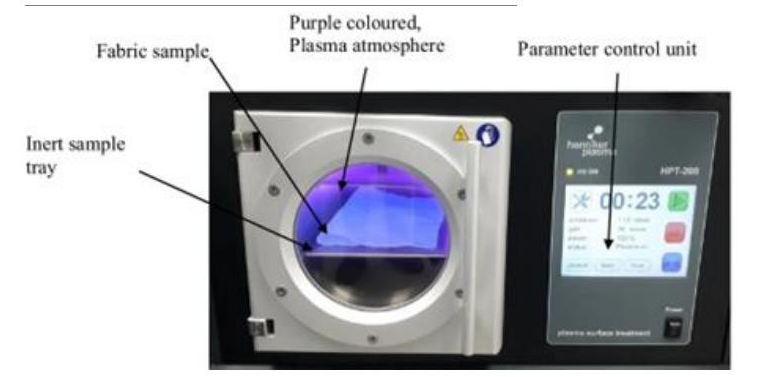
Figure 1: The Henniker HPT-200 with the air plasma visible inside the treatment chamber. Fabric samples sit on an inert tray while treatment time, power and pressure are set from the control unit.
Source: Page 5 of the PDF, Figure 1. Extract at 150 DPI for web.
The results
Wettability was transformed. Grey cotton, which failed to absorb a water droplet even after more than 20 minutes when untreated, took up the droplet in just 6 seconds after plasma treatment. Bleached cotton improved from a 61-second penetration time to 9 seconds after only 3 minutes. Contact angle measurements told the same story: on bleached cotton the water contact angle fell from 93.97°, firmly hydrophobic, to 64.93° after treatment, moving the surface below the 90° threshold where liquids wet readily.
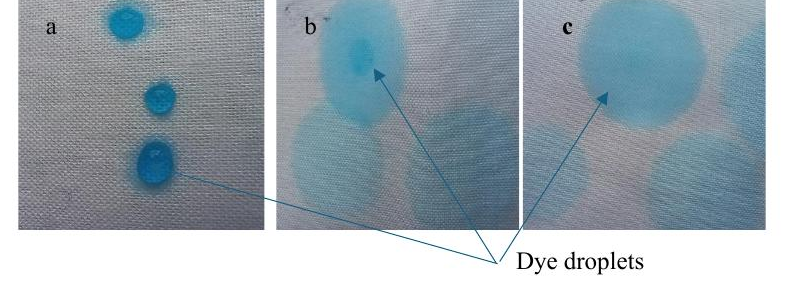
Figure 2: A water-based dye droplet on grey cotton: untreated (a), after 3 minutes of plasma (b) and after 5 minutes (c). On untreated fabric the droplet sits on the surface; after treatment it spreads and is absorbed, showing the shift from hydrophobic to hydrophilic.
Source: Page 12 of the PDF, Figure 6, panels (a)–(c). Extract at 150 DPI for web.
Print durability improved across the board. Colour fastness to washing rose markedly: the colour-change rating for gold pigment on grey cotton improved from 1–2 (a severe change) to 3 after 5 minutes of treatment, and staining ratings reached the maximum of 5 (no transfer) on treated fabrics. Rubbing fastness followed suit. Untreated grey cotton scored just 1 in the wet-rub test for gold, while treated samples improved, with silver on bleached cotton reaching 4–5. Perspiration and light fastness also improved, with the largest gains seen on the gold pigment.
Pigment discharge fell: the sustainability payoff. UV-visible analysis of the wash water showed lower pigment release from plasma-treated fabrics than from untreated ones. Better fixation on the fabric means less colour bleeds into the effluent, which translates directly into reduced wastewater contamination. The surface improvement therefore delivers both a performance benefit and an environmental one from the same single step.
Treatment time is the key process variable. At 3 minutes, the plasma achieved effective surface activation with the fibrillar structure of the cotton largely preserved. At 5 minutes, pigment adhesion and fastness were stronger still, but SEM imaging revealed deeper etching, visible cracks and localised structural degradation. This is a genuine optimisation trade-off between surface activation and fibre integrity. The authors note that a definitive assessment of any effect on fibre strength would require mechanical testing (for example tensile measurements) beyond the surface characterisation reported here.
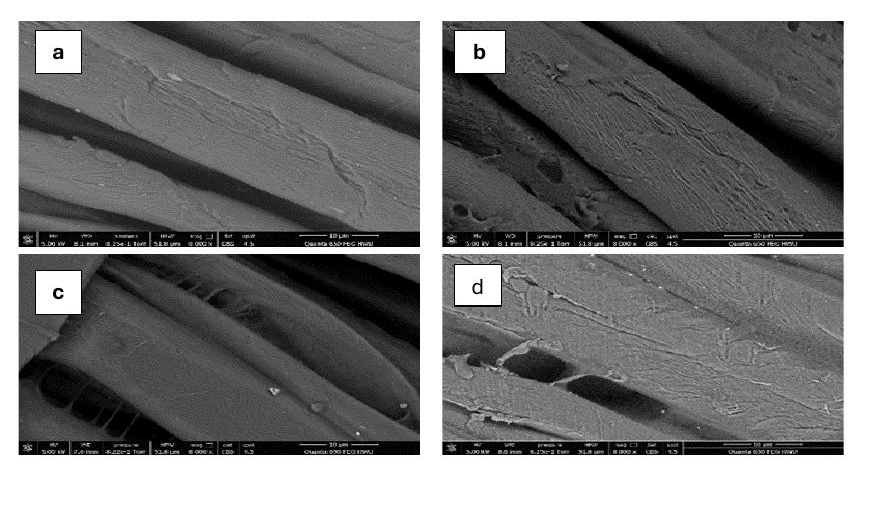
Figure 3: Scanning electron micrographs of cotton fibres before and after 3 minutes of air plasma treatment. Treated fibres (b, d) show increased surface roughness and etching compared with the smooth, untreated fibres (a, c). This micro-topography is what anchors the pigment paste.
Source: Page 18 of the PDF, Figure 11, panels (a)–(d).
Conclusion
A single, dry, air-only plasma step delivered the wettability and pigment adhesion that conventionally demand a multi-stage wet chemical pre-treatment, while cutting water use, chemical consumption and pigment discharge to wastewater.
The HPT-200 used in this study is part of Henniker’s HPT range of vacuum plasma systems, which deliver exactly this kind of surface activation and functionalisation across a wide span of materials and industries. The mechanism that makes cotton printable is oxidative functionalisation combined with controlled micro-etching to raise surface energy, and it is what Henniker’s systems provide for adhesion, printing and coating challenges on difficult-to-wet substrates far beyond textiles. For teams evaluating plasma as an alternative to wet chemistry, Henniker offers both benchtop and production-scale systems, along with a contract plasma treatment service and process-development support to trial the process on your own materials before committing to equipment.
Sustainable manufacturing does not have to mean a performance compromise. This study shows a plasma pre-treatment improving print durability and reducing environmental burden at the same time. Let’s discuss your application.
References
Donkor, S., Sun, D., Bucknall, D. & Buckman, J. (2026). Sustainable Low-Pressure Air Plasma Pretreatment for Metallic Pigment Printing on Cotton Fabrics: Improved Surface Functionality, Fastness Performance and Reduced Environmental Burden. Smart and Sustainable Manufacturing Systems, pp. 1–25. DOI: [to be completed; the DOI was incomplete in the source manuscript].
- Reprinted, from Sustainable Low-Pressure Air Plasma Pretreatment for Metallic Pigment Printing on Cotton Fabrics: Improved Surface Functionality, Fastness Performance, and Reduced Environmental Burden, in Smart and Sustainable Manufacturing Systems (SSMS). Copyright 2026, ASTM International, www.astm.org, DOI: 10/1520/SSMS20260002.
- There are no changes or modifications made to the figures.
FAQs
What is plasma surface treatment?
Plasma surface treatment exposes a material to an ionised gas, known as a plasma, containing reactive species such as ions, electrons and free radicals. These species clean the surface and graft new chemical groups onto it, changing properties like wettability and surface energy without altering the bulk of the material. It is widely used to prepare surfaces for printing, bonding, coating and dyeing.Can carbon fibre composites (CFRP) be plasma treated before bonding?
How does plasma treatment improve printing and dyeing on cotton?
Cotton is naturally hydrophobic, so inks and dyes wet and anchor poorly. Plasma treatment oxidises the fibre surface, adding polar oxygen-containing groups that raise surface energy, and micro-roughens it to create mechanical anchorage points. Together these effects let the pigment or dye spread, penetrate and bond, improving colour fastness to washing, rubbing and perspiration.Should aerospace parts be treated with atmospheric or vacuum plasma?
Does plasma treatment damage cotton fibres?
The chemical and physical changes are confined to the fibre surface, leaving the bulk cellulose structure intact. However, longer exposure increases etching: in this study 5 minutes gave stronger adhesion but also produced deeper etching and localised surface cracking. Treatment time is therefore an optimisation parameter, balancing surface activation against preserving fibre integrity.
Can plasma treatment replace chemical pre-treatment in textile manufacturing?
For pre-treatment before metallic pigment printing, this research shows a dry air plasma step can achieve the wettability and adhesion that conventionally require wet scouring, bleaching and chemical activation. Because plasma uses no water and minimal chemistry, it reduces water consumption, chemical use and effluent, offering a more sustainable route to printable cotton.