Plasma Surface Treatment in Aerospace: Enabling Adhesive Bonding and Lightweighting
How plasma activation of aluminium and composite surfaces supports the shift from mechanical fastening to structural adhesive bonding, and where it fits in the wider drive to reduce aircraft weight and fuel burn.
The aerospace lightweighting challenge
Every kilogram carried by an aircraft has to be paid for in fuel. Weight and lift act in opposition, so a heavier airframe demands more lift to stay in level flight, and generating that additional lift increases induced drag, which in turn calls for more thrust and a higher fuel burn. Reducing structural mass therefore ripples through the entire performance envelope of the aircraft. Lighter is cheaper to fly.
Mechanical fasteners are one of the less visible contributors to that mass. A modern airliner is held together by hundreds of thousands of rivets, bolts and screws, and their combined weight, along with the local reinforcement each joint requires, forms a meaningful proportion of the airframe's dry weight. Adhesive bonding offers an alternative. It is already used in production where geometry defeats conventional fastening, such as attaching wing skins to the stringers in the underlying frame, and it distributes load more evenly than a line of discrete fasteners. Wider adoption, however, depends on one thing above all: bonds that are strong, durable and repeatable. That, in turn, depends on how the surface is prepared before the adhesive is applied.
Why surface perperation governs bond strength
Adhesion is a surface phenomenon. For an adhesive to wet a substrate fully and form a durable joint, the substrate needs a high surface energy (a measure of how readily a surface interacts with liquids and other materials) and a clean, chemically receptive surface for the adhesive to bond to. Where surface energy is low, the adhesive beads up rather than spreading, wettability is poor, and the resulting joint is weak and prone to failure.
Aerospace substrates present specific obstacles. Aluminium carries a native oxide layer and often traces of mill scale, machining oils or handling contamination. Carbon fibre reinforced polymer (CFRP) frequently retains mould release agents from the layup process, along with a resin-rich surface that offers few sites for chemical interaction. Each of these leaves a weak boundary layer between adhesive and structure, the classic precursor to delamination in service. Traditional remedies such as abrasion, grit blasting and chemical priming can work, but they are variable, difficult to control on complex geometries, and in the case of composites can damage the reinforcing fibres.
A useful way to quantify all of this is the contact angle: the angle a droplet of liquid makes with the surface. A high contact angle indicates a low-energy, poorly wetting surface; a low contact angle indicates a high-energy surface ready to bond.
How plasma treatment prepares aerospace surfaces
Plasma surface treatment addresses both problems at once, cleaning the surface and raising its energy, in a single dry, non-contact process. A plasma discharge bombards the substrate with energetic charged particles and reactive species. The result is a remarkable and immediate increase in surface energy, achieved without abrasives, solvents or fibre damage.
Two mechanisms are at work. Plasma cleaning removes organic contamination, release agents and hydrocarbons at the molecular level, stripping away the weak boundary layer that undermines bonding. Plasma activation then grafts polar functional groups, such as hydroxyl, carbonyl and carboxyl species, onto the surface. These groups raise surface energy and provide chemically active sites that form strong secondary and covalent interactions with the adhesive, rather than relying on mechanical keying alone.
Both aluminium and CFRP respond well. On aluminium, plasma treatment produces a clean, high-energy oxide surface that adhesives wet readily. On CFRP, it functionalises the resin-rich surface without disturbing the fibres beneath, a decisive advantage over abrasive preparation. The process is repeatable and straightforward to integrate into a production line, which matters as much in aerospace manufacturing as the bond strength itself.
The choice of system follows the part. Atmospheric plasma treatment suits large panels, continuous inline processing and localised treatment of specific bond lines. Vacuum (low-pressure) plasma treats discrete components uniformly and handles intricate geometries where every surface must be reached. For applications that need a durable functional layer rather than activation alone, plasma-deposited nano-scale coatings, such as those in Henniker's CoatX platform, can lay down a covalently bonded primer that enhances and extends bond performance.
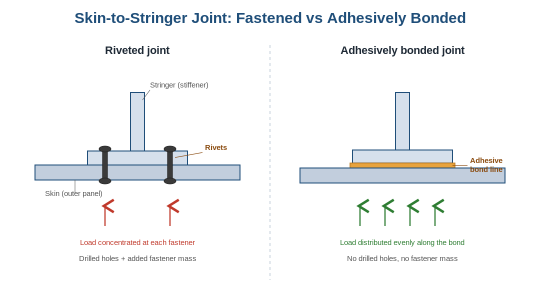
Figure 1. A riveted skin-to-stringer joint (left) beside an adhesively bonded joint (right). The bonded design removes fastener mass and drilled holes, and distributes load evenly along the bond line rather than concentrating it at discrete fasteners.
Schematic diagram (cross-section, not to scale).
For stronger bonds to lower weight and fuel burn
The engineering payoff follows directly from the physics set out above. Reliable, well-characterised bonds allow designers to replace mechanical fasteners in more locations, and to use adhesive joining where the geometry once made it too risky. Fewer fasteners means less fastener mass and less local reinforcement, which lowers airframe weight. Lower weight reduces the lift required, which reduces induced drag, which lowers the thrust and fuel needed to sustain flight. Surface preparation, in other words, sits at the start of a chain that ends in lower operating cost over the life of the aircraft.
The scale of any given saving depends entirely on the aircraft and the extent of bonded construction, so it is not something to put a single headline figure against. The mechanism, though, is well established, and it explains why adhesive bonding continues to displace mechanical fastening wherever the joint can be qualified with confidence.
Conclusion
Across aerospace structures, the route to lower weight and lower fuel burn increasingly runs through adhesive bonding, and the reliability of that bonding rests on surface preparation. Plasma treatment cleans and activates aluminium and composite surfaces in a single controllable step, raising surface energy and creating the chemistry that strong, durable joints demand, without the fibre damage or process variability of abrasive methods.
Henniker Plasma brings more than twenty years of experience in solving adhesion challenges of exactly this kind, across atmospheric and vacuum plasma systems and the CoatX nano-scale coating platform. For teams evaluating plasma treatment for a bonding or lightweighting application, contract plasma treatment offers a low-risk way to test the process on real components before any capital commitment
FAQs
Does plasma treatment improve the adhesive bonding of aluminium?
Yes. Plasma treatment removes organic contamination and oxides from the aluminium surface and raises its surface energy by adding polar functional groups. This improves wettability and produces stronger, more durable adhesive joints than untreated aluminium, without abrasives or solvents.
Can carbon fibre composites (CFRP) be plasma treated before bonding?
Yes. Plasma treatment functionalises the resin-rich surface of CFRP and removes mould release agents, creating chemically active sites for the adhesive. Because it is non-contact, it does this without damaging the reinforcing fibres, which is a key advantage over grit blasting or sanding.
Should aerospace parts be treated with atmospheric or vacuum plasma?
It depends on the part. Atmospheric plasma suits large panels, inline processing and localised treatment of specific bond lines, while vacuum (low-pressure) plasma treats discrete components and complex geometries uniformly. Both raise surface energy for bonding; the right choice follows the component and production volume.
Why is plasma treatment preferred over sanding or grit blasting for composites?
Sanding and grit blasting are abrasive and can damage the reinforcing fibres in a composite, introducing variability into the bond. Plasma treatment is non-contact and repeatable, cleaning and activating the surface without mechanical damage, which makes it well suited to the tight process control aerospace bonding demands.